Features
From the technical data sheet to the digital passport, without re-typing anything by hand.
FormulaPass accompanies the product from importing existing documents through to the QR code published on the packaging, with data checks and human confirmation at every step.
Smart PDF import
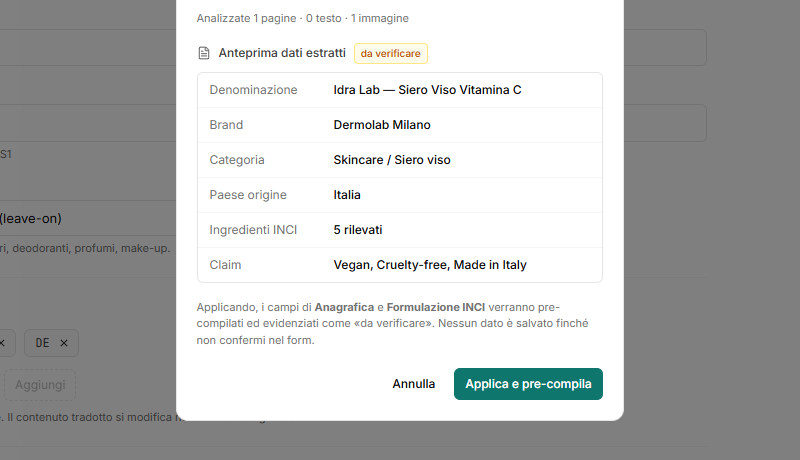
Upload the technical data sheet or the PIF as they are, scans included: FormulaPass extracts the master data and INCI formulation in a few minutes.
No data is saved automatically: the extracted fields stay highlighted as "to be checked" until you confirm them, field by field.
INCI nomenclature checking
Every ingredient in the formulation is compared against a reference list of INCI names: a badge immediately flags whether the name is recognised, unknown, or likely affected by a typo.
If there is a typo, a correction is offered: you apply it with one click and it remains your decision, because nothing is rewritten automatically.
The obligations that already have a date
The digital passport, for cosmetics, is still voluntary. These three things are not.
Regulation (EU) 2023/1545
Fragrance allergens on the label
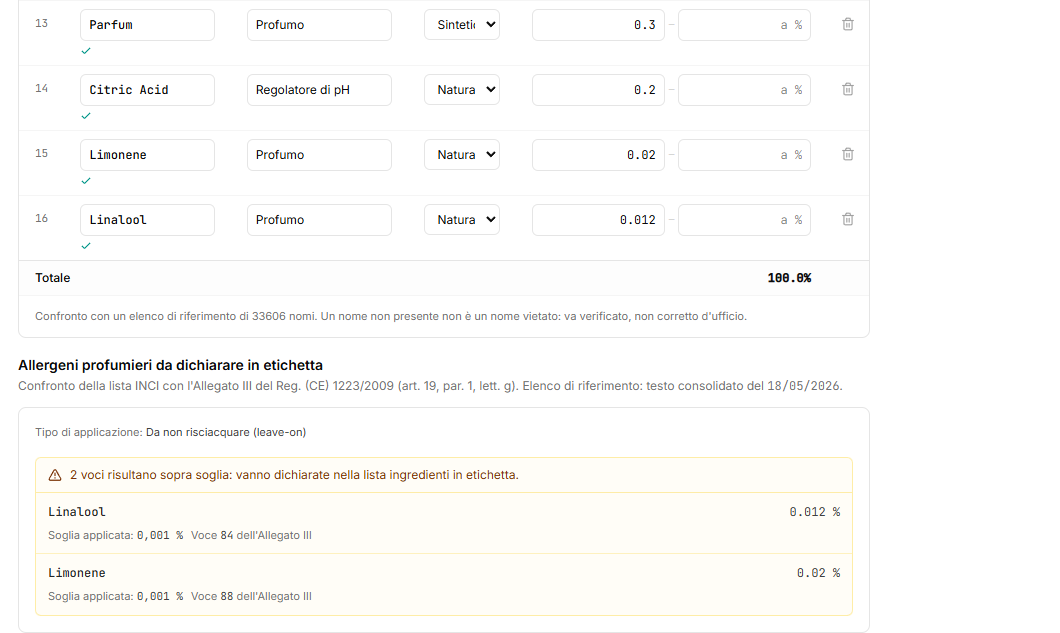
The Annex III list went from 26 to more than 80 substances. From 31 July 2026 products placed on the market must declare them; from 31 July 2028 those that have not been updated can no longer be made available.
FormulaPass compares the formulation against Annex III as it stands and tells you which substances must be declared on the label, with the threshold that applies to your product. When the data you hold is not enough to decide — a percentage given as a range in the PIF, say — it flags it, instead of choosing for you.
PPWR — Regulation (EU) 2025/40
Packaging data
It applies from 12 August 2026 in every Member State, with no national transposition, with further deadlines between 2028 and 2030.
FormulaPass collects the packaging data in structured form — materials, recyclability, components and their collection scheme — validates it and publishes it on the passport reachable from the QR code: what you need for compliance, in one place and in a reusable format.
For small formats the PPWR allows part of the information to sit on a digital carrier, when the packaging surface is not enough: the passport reachable from the QR code is that carrier. The exact thresholds will arrive with the implementing acts, and until they exist we do not write about them.
Regulation (EU) 1007/2011
Textile fibre names
To describe the composition of a textile product you may use only the names listed in Annex I. It has been in force for years. And it is the sector where the digital passport becomes mandatory: the delegated act is expected in 2027, application not before the end of 2028.
FormulaPass compares every fibre against the names allowed by Annex I and checks that the declared percentages add up. When the data you hold is not enough to decide, it tells you instead of choosing for you.
FormulaPass collects, compares and flags. It issues no declarations of conformity and does not replace the Responsible Person's assessment, or that of whoever places the product on the market.
- 01 · Master data name, brand, GTIN, batch
- 02 · Formulation INCI, percentages, allergens
- 03 · Packaging data required by the PPWR
- 04 · Declarations CPNP, Responsible Person, PIF
- 05 · Claims and sustainability
- 06 · DPP and QR preview, versions, print
DPP editor in 6 sections
Master data, INCI formulation, packaging, sustainability, marketing and DPP/QR: every aspect of the product has a dedicated section, fillable by hand or pre-populated from the PDF import.
A live preview shows at every moment how the passport's public page will appear to the consumer who scans the QR code.
GS1 QR code, ready for print
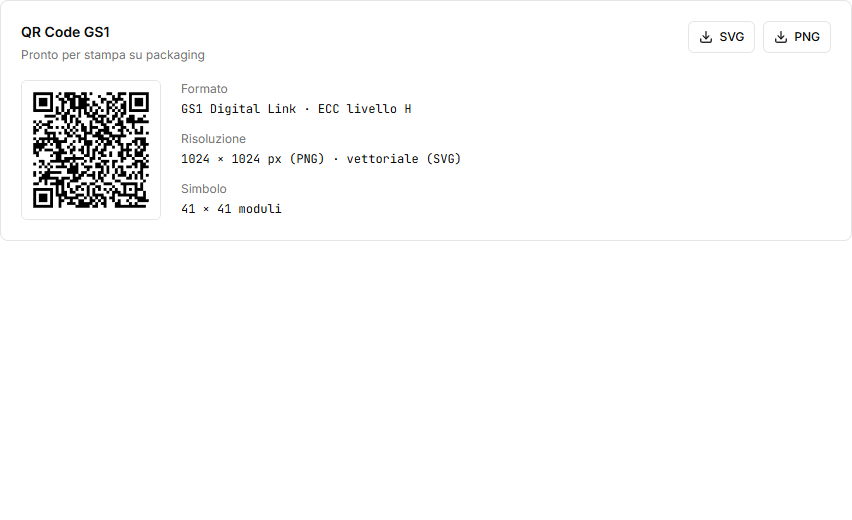
The passport is published with a QR code compliant with GS1 Digital Link, generated to stay readable even if the label is scratched or partly covered.
You download it as a vector SVG or a high-resolution PNG, already traceable to the right product: ready to hand to the graphics department or packaging supplier, who sizes it to their own print specifications.
| Mon | 12 |
| Tue | 18 |
| Wed | 9 |
| Thu | 21 |
| Fri | 27 |
| Sat | 34 |
| Sun | 15 |
Scan analytics
Every scan of the public QR code is aggregated into a dashboard showing the trend over time, the number of distinct visitors and the comparison across your products.
The public page sets no cookies, contains no JavaScript and does not keep the IP address of whoever opens it. No consent banner, no external analytics tool.